If you run a card shop, an online store or a vending operation in Europe, the difference between paying the right wholesale price and the wrong one is your entire profit. This guide covers what Pokémon TCG product really costs at wholesale in Europe in 2026, what makes prices move, and how to read a price list like a professional buyer.
The short version: 2026 wholesale price ranges
These are realistic market ranges for sealed, original product bought B2B in the EU. Exact quotes depend on set, volume and timing, but if an offer lands far outside these bands you should ask why.
Japanese booster boxes (current sets). Roughly 25-90 EUR per box for most sets in print. Recently launched sets with strong chase cards trade at the top of the band; high-supply reprint waves push older sets to the bottom.
Japanese special and premium sets. Special sets, half-size starter products and themed collections range widely, from around 20 EUR for compact starter formats up to 100-150 EUR for premium boxes. Pokémon Center exclusives carry a premium because they never enter normal distribution.
Discontinued and chase boxes. Sets that are out of print, such as fan favourites from previous generations, no longer follow print-cost logic. They are priced by scarcity, move like collectibles, and can exceed 250-300 EUR per box wholesale. Buy them for rotation, not decoration.
Korean booster boxes. The value play of the market: most Korean sets mirror the Japanese equivalent with identical artwork at a noticeably lower price, commonly in the 40-70 EUR band. That gap is why Korean product has become the entry point for price-sensitive customers across Europe.
Booster packs for vending. Bought as boxes and broken into packs, the per-pack wholesale cost of Japanese product typically lands well under 2 EUR, which is what makes card vending machines profitable at 4-6 EUR retail per pack.
What actually moves wholesale prices
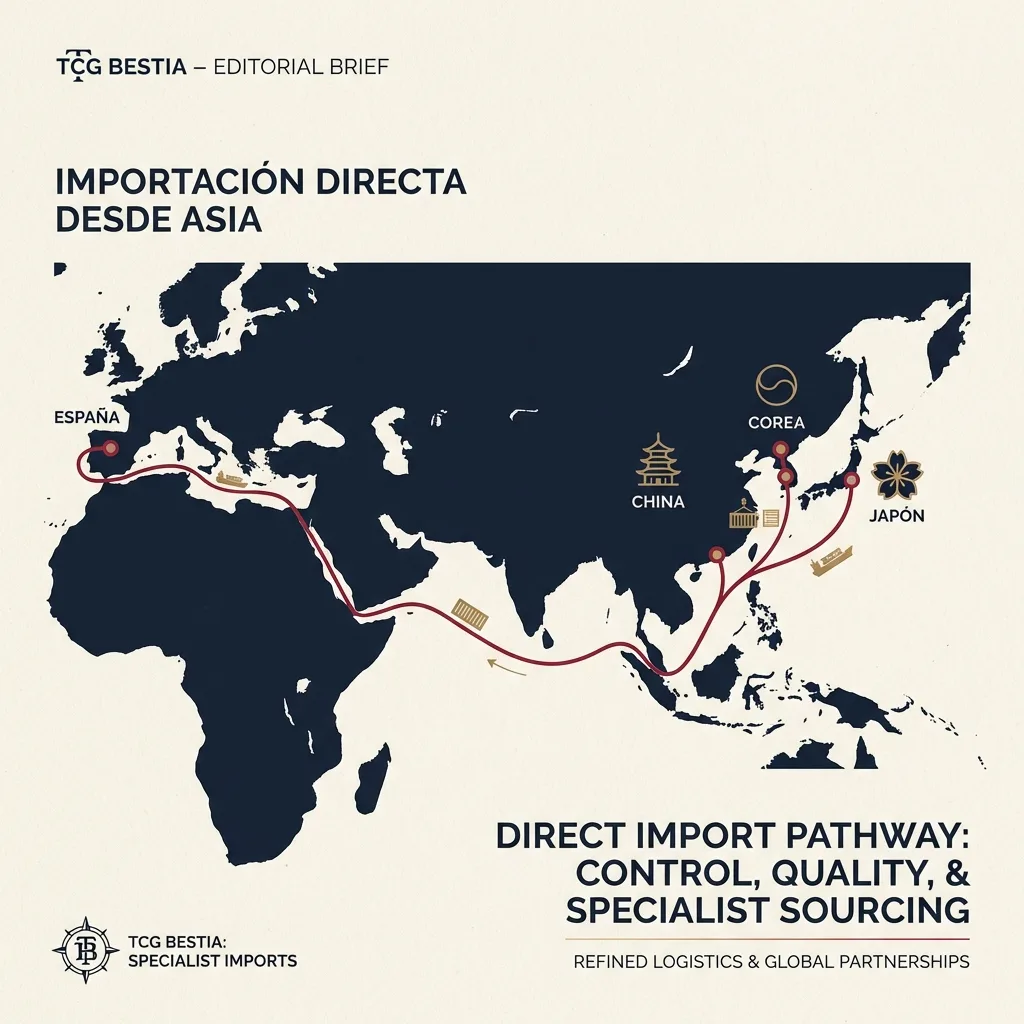
Distance from the source. Every intermediary between the Japanese market and your store adds a margin layer. Product that flows Japan → national wholesaler → regional distributor → you costs structurally more than product a direct importer brings into Europe in one step. Same box, different chain, different price.
Print waves. Japanese sets get reprinted in waves. When a reprint lands, wholesale prices dip; when a wave sells through and the next one is months away, prices climb. A good supplier tells you where in the cycle a set is. If yours does not, ask.
The yen. Wholesale prices in euros absorb the JPY/EUR rate at the moment the importer bought, not the moment you order. This is why two honest suppliers can quote the same set 10% apart, and why locking recurring supply with one importer smooths your costs over the year.
Collector demand. A set with a chase card that explodes on the secondary market will see its sealed box price climb within weeks. This works in your favour if you stocked early — one more reason to follow new Japanese releases before they reach European awareness. Our guide to Japanese Pokémon booster boxes wholesale covers how to pick sets.
Margin math: a real example
Say you buy a current Japanese set at 55 EUR per box wholesale and sell single boxes at 85-95 EUR retail, or break the box into 30 packs at 4,50 EUR each (135 EUR gross per box):
- Sold as sealed boxes: 30-40 EUR gross margin per box, low handling effort.
- Sold as packs: roughly 80 EUR gross margin per box, more handling, ideal for vending and walk-in traffic.
Most healthy stores mix both: sealed boxes for collectors and regulars, packs for impulse buyers and machines. If you are still building your assortment, start with our breakdown of what a Pokémon TCG distributor in Europe should offer.
Price traps: when cheap is expensive
Prices far below market. Sealed Japanese product has a real cost floor: market price in Japan plus freight plus import. Offers 30-40% below every other supplier mean grey product, resealed boxes or outright fakes. Our guide on how to spot fake Japanese Pokémon cards shows what to check before you pay anyone.
"Wholesale" prices that are retail in disguise. Some marketplaces list single boxes at collector prices and call it wholesale. A real B2B price list quotes without VAT, scales with volume and holds stock behind it.
Hidden landing costs. A quote from outside the EU may look attractive until you add import VAT, customs handling and the risk of a stopped parcel. An EU supplier with stock already imported quotes a final price — what you see is what lands.
How to compare suppliers properly
- Ask for the same basket. Quote 3-4 specific sets, same quantities, from each supplier. Compare landed cost, not headline price.
- Check the invoicing. A serious EU wholesaler invoices intra-community with your VAT number under the reverse charge regime. No proper invoice, no deal.
- Look at restock speed. The cheapest first order is worthless if the supplier cannot refill your best seller for six weeks. Rotation pays your rent, not one order.
- Verify authenticity policy. Who checks the product, where, and what happens if something arrives wrong.
For a wider comparison of the supply channels available to European stores, see the best Pokémon TCG distribution options in Europe.
What TCG Bestia quotes look like
TCG Bestia imports directly from Japan and Korea and distributes to stores across the whole EU from stock held in Europe. That single-step chain is what lets us quote below traditional national distribution while staying 100% original and sealed:
- Request a B2B account — two minutes, we validate that you are a real business with an intra-community VAT number.
- See real prices on real stock — the wholesale catalogue shows live prices tracked against the Japanese market.
- Order what your store needs — from a first test order to a recurring monthly plan. No exclusivity, no forced bundles.
- Receive it in days — shipped from Europe, tracked, invoiced intra-community.
Want to see the actual price list? Request your wholesale account and compare us against whatever you pay today. That comparison is the whole pitch.