There is no single best Pokémon TCG distributor in Europe: stores supply themselves through four channels, which are official national distributors, European master distributors, direct importers of Asian product, and marketplaces and brokers. This TCG Bestia guide compares how each channel works, its typical margins and the kind of store it suits.
This guide compares the four channels European stores actually use in 2026 — how each one works, the margins you can realistically expect, and where each one fits — so you can build a supply strategy instead of just picking a name from a list.
The 4 types of Pokémon TCG distributor in Europe
1. Official national distributors
Most European countries have one or more distributors appointed to supply localized Pokémon TCG product — English, German, French, Italian or Spanish sets — through the official channel.
How it works: you open a trade account, usually with a business registration, a physical or established online store, and an opening order. Allocations for high-demand sets are distributed among account holders, which means you rarely get everything you ask for during hype cycles.
Typical margins: the official channel is built around a suggested retail price.
Strengths: localized product in your customers' language, access to organized play materials, prerelease support, and predictable release calendars. If you run tournaments, you need this channel — there is no substitute for official organized play support.
Weaknesses: allocation limits during high-demand releases, opening order requirements, and margins that keep shrinking as more stores compete on the same localized product.
Best fit: stores with a strong tournament community and customers who play the game in their local language.
2. European master distributors
Above the national level sit large pan-European distributors that supply smaller wholesalers and big retail chains across multiple countries.
How it works: these companies move very large volumes and generally expect serious order sizes. Some sell to independent stores directly; many effectively serve other distributors.
Typical margins: slightly better unit prices than national distribution if your volume is high enough, but the difference for an independent store is usually small once shipping is included.
Strengths: broad catalogs that go beyond one game — useful if you also stock board games and accessories and want one invoice for everything.
Weaknesses: minimums designed for chains, not independents. You are the smallest customer on their list, and allocations reflect that.
Best fit: multi-store operations and retailers with high, predictable volume.
3. Direct importers of Asian product
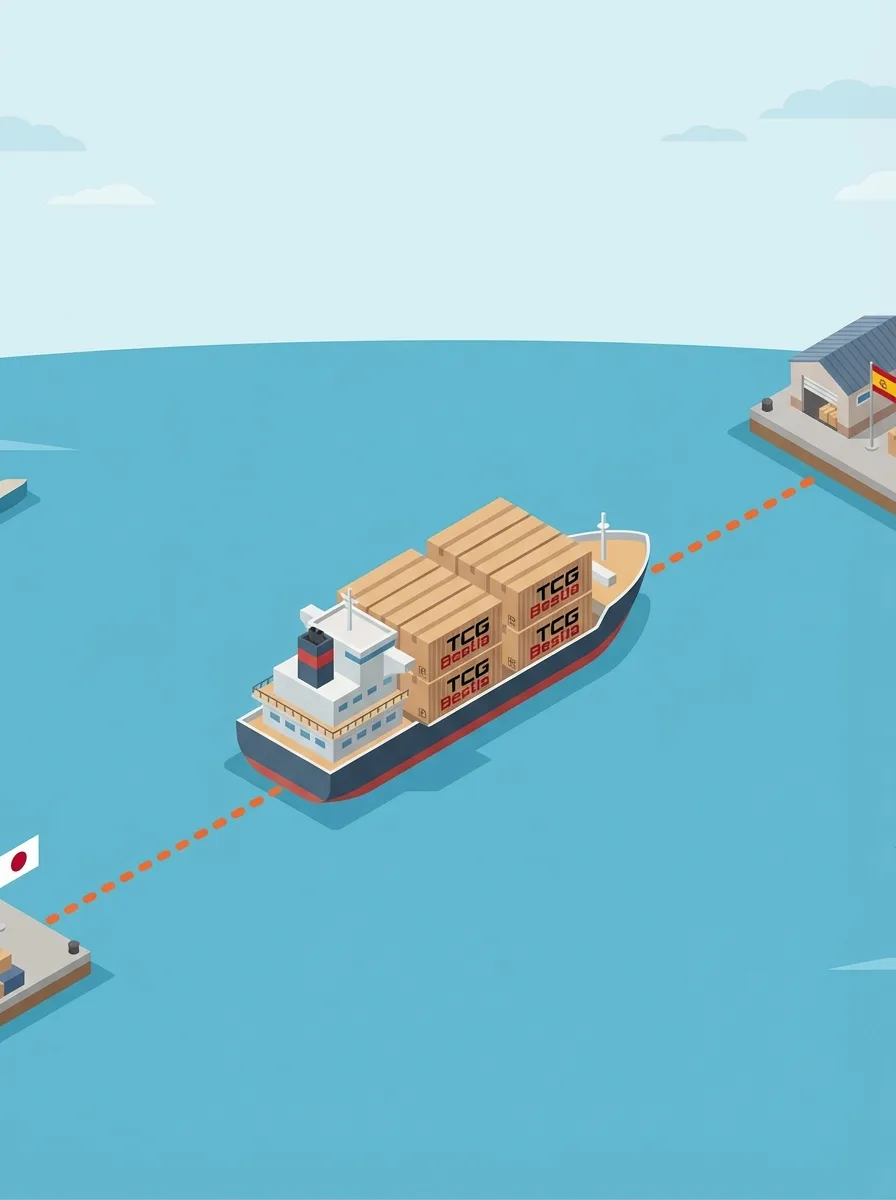
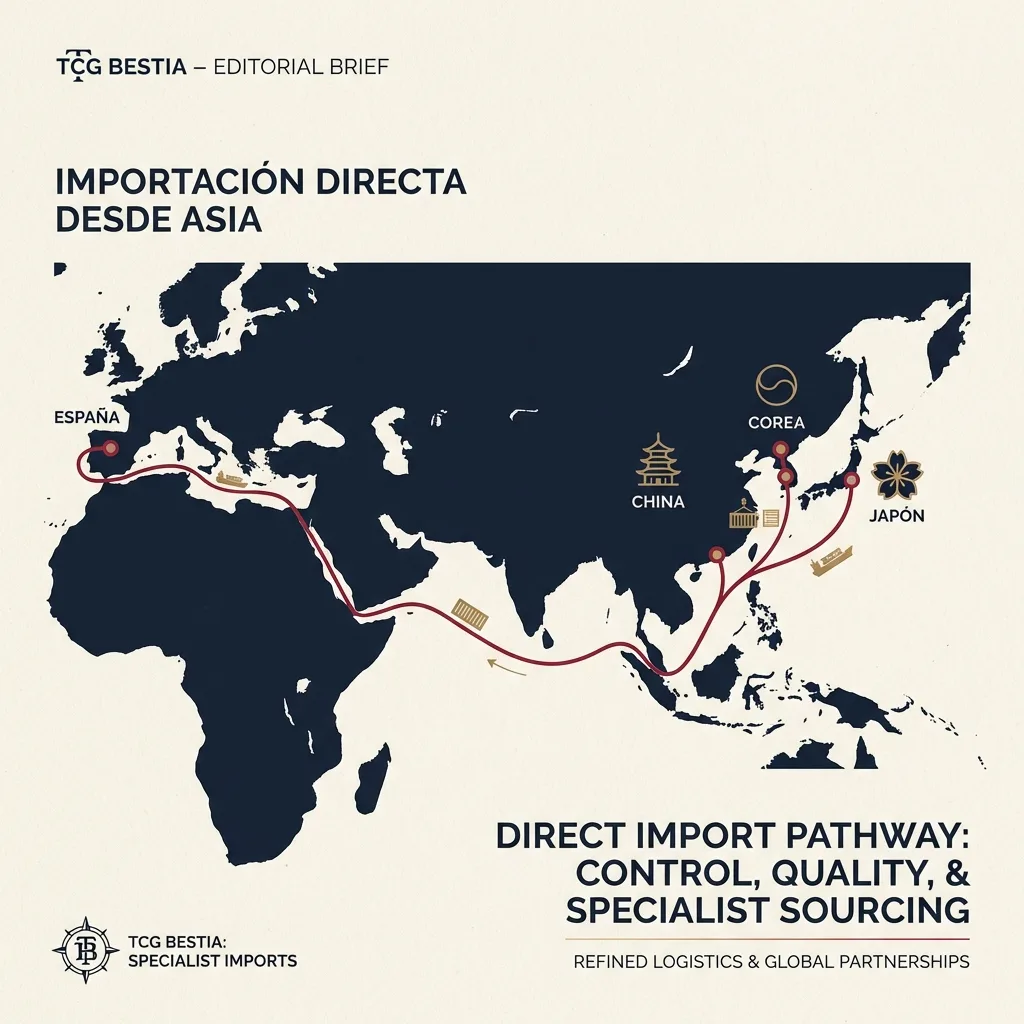
This is a channel that has gained ground in recent years, and it is the one TCG Bestia operates in. A direct importer buys original product in Japan, Korea and China, verifies it at origin, brings it into the EU, and sells it wholesale from European stock.
How it works: the importer handles customs, freight and authenticity verification. You buy from stock already in Europe, invoiced as an intra-community supply without VAT if you have a valid VAT number and receive it from European stock. TCG Bestia ships this way within the EU, with support in English and Spanish.
Exclusive product — Japanese special sets, Pokémon Center boxes, Korean printings — has no official European equivalent, so pricing pressure from competitors is much lower.
Strengths: wider margin room than the official channel, access to product that never reaches official European distribution, no allocation politics, and differentiation — your shelves stop looking identical to every other store in your city. TCG Bestia verifies product at origin, which addresses the main historical risk of this channel.
Weaknesses: the product is in Japanese, Korean or Chinese, so it serves collectors and openers more than tournament players. It does not come with organized play support. And the channel has lower barriers to entry, which means you must vet suppliers carefully — see our guide on how to choose a Pokémon TCG distributor in Europe.
Best fit: stores serving collectors, stores that want margin room to compete online, vending operators, and any store that wants exclusive product alongside its official-channel stock.
4. Marketplaces and brokers
Finally, there is the gray middle: B2B marketplaces, broker groups and one-person "wholesalers" reselling from a spare room.
How it works: you buy case lots or mixed pallets from whoever has them, often internationally, often payment-first.
Typical margins: anywhere from excellent to negative. Brokers shine when someone needs to liquidate; they are also a common source of fake and reseal problems.
Strengths: occasional genuine bargains and access to out-of-print product.
Weaknesses: no continuity of supply, no accountability, and real counterfeit risk on Japanese product bought sight-unseen.
Best fit: experienced buyers filling gaps — never as a primary supply channel.
Side-by-side comparison
| Channel | Exclusive product | Organized play | Counterfeit risk |
|---|---|---|---|
| Official national distributor | No | Yes | Very low |
| European master distributor | No | Partial | Very low |
| Direct importer (Asian product) | Yes | No | Low with a verified importer |
| Marketplaces / brokers | Sometimes | No | High |
How to choose: three questions that decide it
1. Who buys from you? If your revenue comes from tournament players, the official channel is non-negotiable. If it comes from collectors and pack-openers — where demand has been shifting — Japanese and Korean product from a direct importer can earn more per shelf metre than localized stock.
2. Do you need margin room? Direct-import product is what creates it. Our breakdown of Japanese Pokémon booster boxes at wholesale explains how to think about the economics per box.
3. Can you verify your supplier? Whatever channel you use, demand a commercial invoice, an EU VAT number, and proof of European stock. If you are just planning your store, our guide on how to open a TCG store in Europe covers supplier vetting from zero.
What changed in 2026
Two shifts are reshaping how European stores buy this year. First, collector demand has kept moving toward Japanese and Korean product: exclusive sets, alternate arts and Pokémon Center boxes now drive a growing share of sealed sales in many stores, and none of it flows through the official European channel. Second, allocation pressure on localized product has not eased — stores that rely on a single official account still cannot get enough of the sets their customers ask for, which pushes even conservative buyers to add a second supply line.
The consequence: the question stores ask in 2026 is no longer "which distributor should I pick?" but "how do I combine channels so no single supplier can choke my shelves?"
The realistic 2026 strategy
Many stores in Europe do not pick one channel. They keep an official account for localized product and organized play, and they add a direct importer for Japanese, Korean and exclusive product — which is where the margin room and the differentiation live.
Before you compare quotes, know the market: our guide to Pokémon TCG wholesale prices in Europe covers how to read prices by product type, and the European TCG market report looks at what European stores are buying. You can also browse the full catalogue for stores, set by set, across Japanese and Korean Pokémon, One Piece and Dragon Ball; availability and pricing are shown inside your wholesale account.
If you want to see what the direct-import channel looks like in practice — catalog, pricing tiers and conditions — request a wholesale account and we will answer.