Japanese Pokémon booster boxes have gone from a niche collector item to a product line many European card stores now consider. If you have watched customers walk in asking for "the Japanese 151 box" and had nothing to offer, this guide explains how the wholesale side works — sets, import and the traps to avoid.
Why Japanese boxes are a different business than English ones
Three structural differences make Japanese product attractive for a store:
1. A different cost structure. Japanese product follows its own market and pricing, which can leave more room for your own pricing than the English equivalent, even after import and logistics. Always compare real quotes.
2. Exclusive sets. A large part of the Japanese catalogue never gets an official European release: special sets, Pokémon Center exclusives, anniversary collections. Exclusivity is demand you cannot satisfy with the official channel — but your customers still feel it.
3. A collector-driven life cycle. Japanese sets can go out of print faster. A box bought at a normal wholesale price can gain value once the set is discontinued, although this is never guaranteed. Stores that understand this cycle benefit twice: from rotation while the set is live, and from the stock they hold when it ends.
The sets that move in 2026
Without turning this into a price list (prices move weekly with the yen and reprints), these are lines European stores commonly look at:
- Pokémon Card 151 (SV2a) — a perennial favourite. Kanto nostalgia plus full-art cards make it an easy box to explain to customers.
- Shiny Treasure ex (SV4a) — the "chase box" par excellence. Its alternative arts make it popular with collectors on social media.
- The Mega line (M1L, M1S, M2a...) — the current generation of Japanese sets.
- White Flare / Black Bolt (SV11) — a recent large release.
If you are starting, do not try to carry everything: two or three proven sets rotate better than ten exotic ones.
How wholesale import actually works
The part that intimidates most store owners — customs, VAT, logistics — is precisely the part a good distributor removes from your plate.
When you buy from an importer with stock already in Europe, like TCG Bestia, there is no import process on your side at all. The distributor already cleared the goods. Your purchase is a normal intra-community B2B transaction:
- You order from the wholesale catalogue.
- If you have a valid EU VAT number, the invoice is issued without VAT under the intra-community supply regime, and you account for VAT in your country.
- The shipment leaves the European warehouse and arrives with tracking.
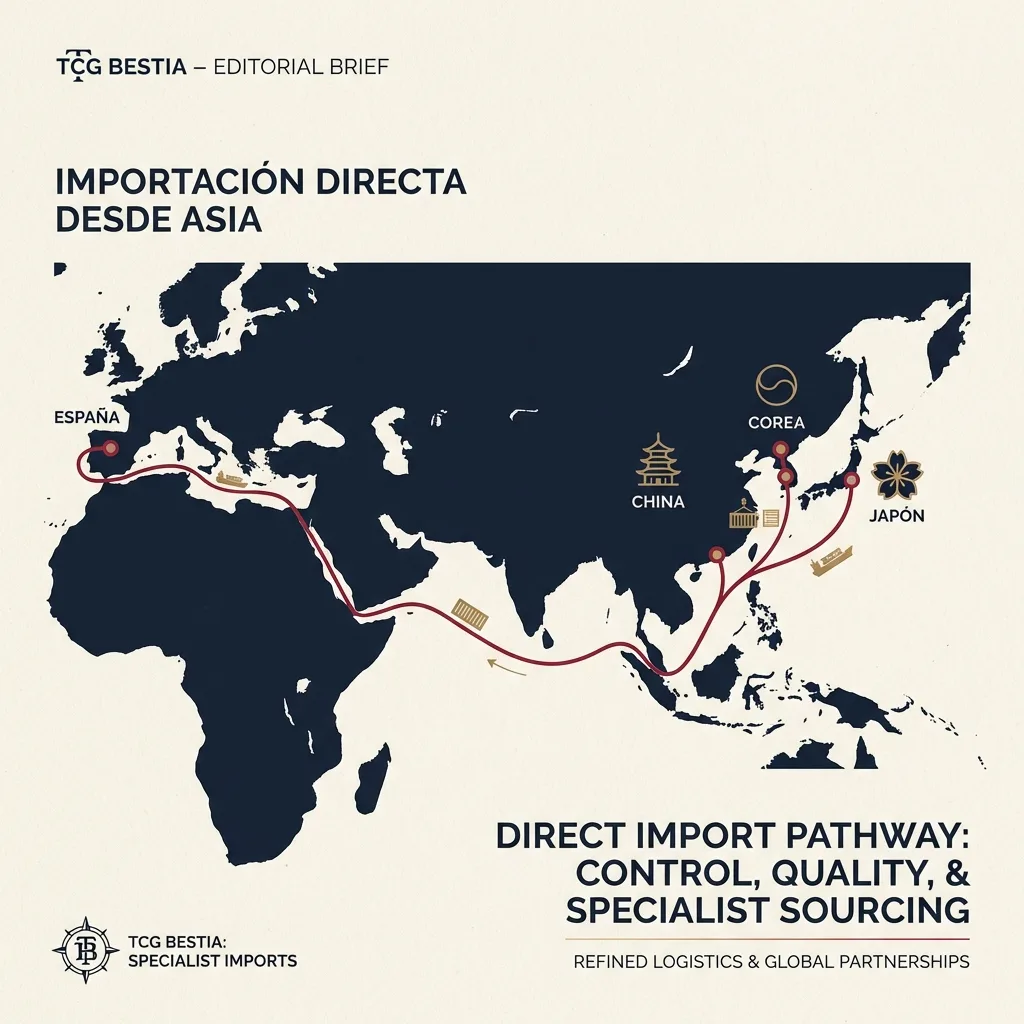
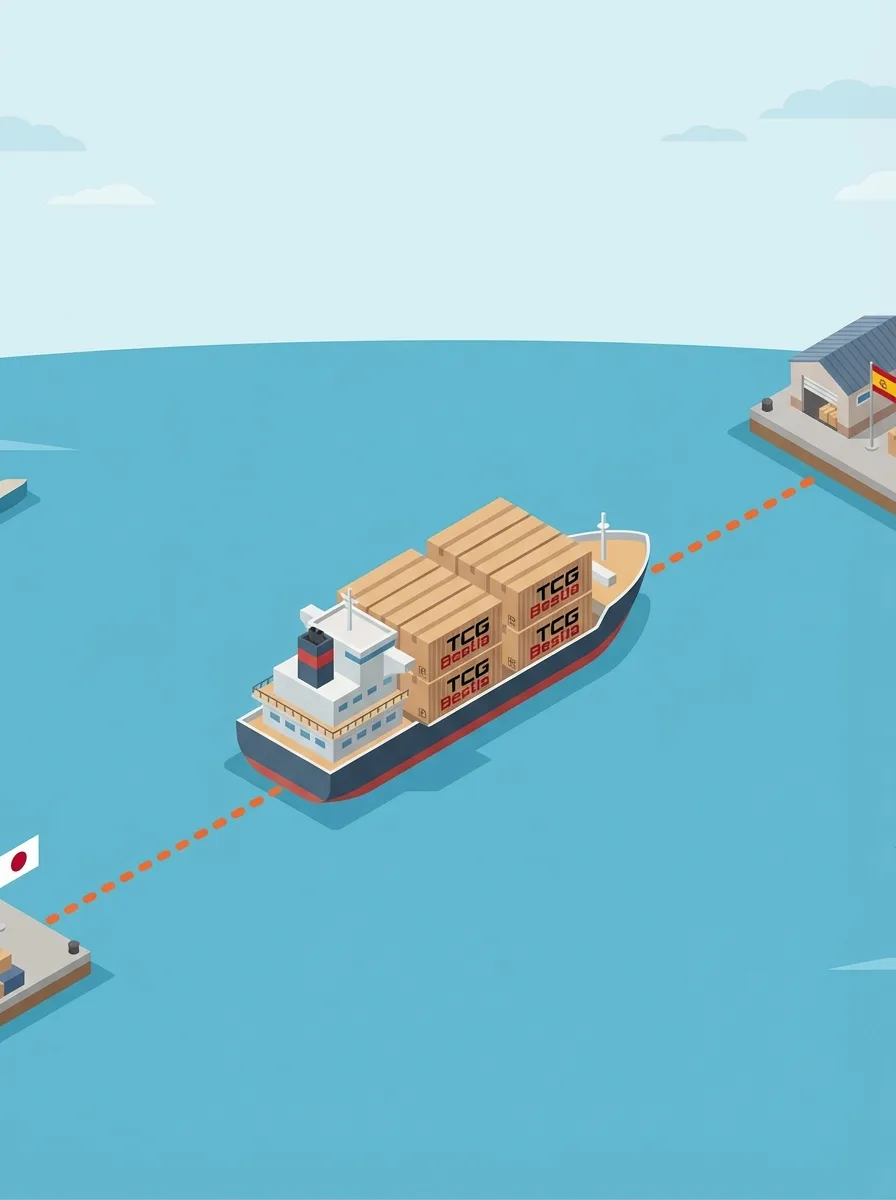
Compare that with buying directly from Japan yourself: proxy services, international freight, customs broker fees, import VAT advanced at the border and a long, uncertain wait. Direct import may make sense at very large volumes; for most stores, buying through an EU importer saves a lot of time and effort.
The reseal problem (and how not to become its victim)
The flip side of the Japanese boom is the fake and reseal market. Resealed boxes — opened, stripped of their best packs and rewrapped — circulate through marketplaces and unverified brokers. For a store, selling one resealed box to a customer can destroy a reputation built over years.
The defence is boring but effective: buy only from suppliers that document verification at origin. Ask specifically:
- Is the factory seal (shrink) original, and how do you check it?
- Do you weigh boxes against factory reference weight?
- Can you trace each batch to its source in Japan?
Any serious distributor answers those three questions without hesitation. If the answer is vague, walk away — no discount covers that risk.
What a first order looks like
A sensible first Japanese order for a European store is not huge: a few boxes of two proven sets (151 and Shiny Treasure are the usual choice), possibly padded with singles-friendly product or accessories to optimise shipping per unit. That tests real demand in your local market with contained risk.
From there, most stores settle into a monthly rhythm aligned with the Japanese release calendar — new sets come out regularly, and pre-ordering strong releases at wholesale is where many opportunities live.
To understand what drives the cost of that first order, see Pokémon TCG wholesale prices in Europe.
The anniversary set 30th Celebration has its own wholesale guide.
Ready to test Japanese product in your store? Request a B2B account and we will give you access to the current wholesale catalogue.