Dragon Ball Fusion World can be bought wholesale in Europe from a direct importer that brings the product in from Japan and holds it in a European warehouse. This TCG Bestia guide covers why the line is growing, which sets to stock first and what to demand from a Fusion World wholesale supplier.
This guide covers what a European store needs to know in 2026: why the line is growing, which sets to stock first and how buying Dragon Ball Fusion World wholesale from a direct importer actually works.
Why Fusion World is the third line worth shelf space
Dragon Ball has something few licences can claim: three generations of fans who recognise the characters instantly, in every European country. Fusion World turned that brand power into a modern, well-supported card game with a clear release calendar and strong organised play.
For a store, the commercial case rests on three points:
1. Less competition on the supply side
Pokémon is sold almost everywhere, so room for manoeuvre on European-language Pokémon product tends to be tight. Fusion World — especially Japanese-language Fusion World — is a different story. Fewer stores seem to stock it seriously, which can mean less price erosion and customers who travel (physically or online) to the stores that do.
2. A collector base that prefers Japanese product
As with Pokémon and One Piece, the most engaged Dragon Ball collectors actively look for Japanese boxes: first print runs, exclusive alternate arts and packaging that never reaches the European channel. If you already sell Japanese Pokémon, Fusion World Japanese product slots into the same customer base. Our guide to Japanese Pokémon booster boxes at wholesale explains that dynamic in detail — it applies almost identically here.
3. A shorter chain
Bought through the traditional chain (manufacturer → European master distributor → national distributor → store), every step adds cost before the product reaches you. On a line that rotates as fast as Fusion World currently does, a shorter chain makes a real difference to what you can offer.
The sets that actually sell in 2026
Not every box deserves the same order size. Demand for a card game like this typically concentrates in three places:
- Latest main-set boosters. The current Fusion World expansion always leads rotation. Customers open product while the metagame is fresh, and displays move fastest in the first weeks after release.
- Starter and structure decks. The entry point for new players, and the product most requested by stores building a local play community. Low ticket, high frequency.
- Older sets with chase cards. Once an expansion goes out of print in Japan, boxes can appreciate. Stores that bought early may sell remaining stock at collector prices — this is where a direct importer's early access matters most.
A practical starting mix for a store new to the line: two thirds current-set displays, one third starters plus one or two sealed boxes of the previous set. Adjust from your own sell-through after the first cycle.
How direct import works — and why the chain matters
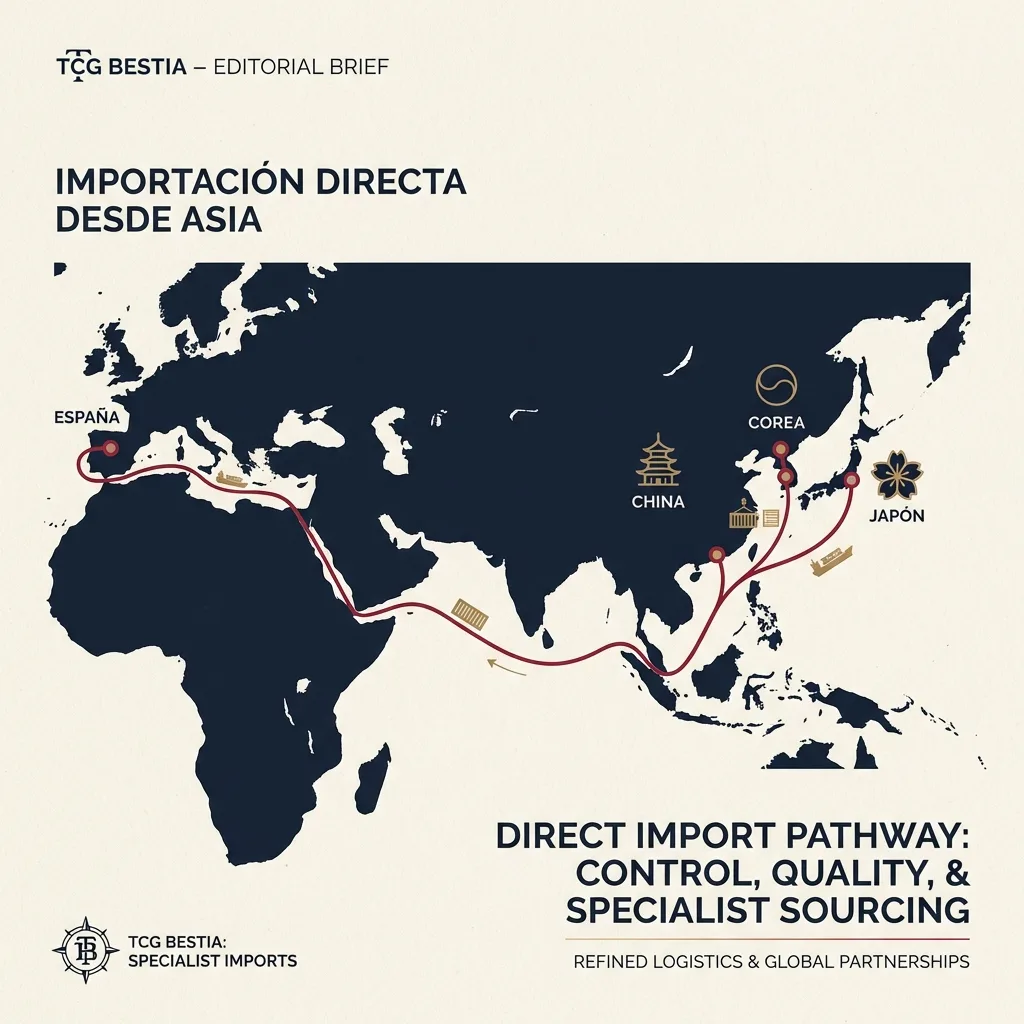
The traditional distribution chain exists for convenience, not efficiency. Every intermediary between Bandai and your shelf adds cost and subtracts catalogue depth. The alternative model is simple: an importer buys in volume in Japan, ships to Europe, clears customs once, holds stock in a European warehouse and sells directly to stores.
That is exactly how TCG Bestia operates. We import directly from Japan, Korea and China, verify authenticity at origin and hold stock in Europe. Because the product has already cleared customs, your delivery is a normal intra-EU shipment: no import paperwork on your side, no surprise fees.
If your business has a valid intra-community VAT number, invoicing is clean: we bill without VAT under the intra-community supply regime, and you apply VAT in your own country. The full process — quote, order, invoice, tracking — runs in English or Spanish, whichever you prefer.
We covered the general model in our guide to being a Pokémon TCG distributor in Europe; the logistics for Dragon Ball are identical, and the two lines usually ship together in the same order.
Japanese versus European-language product: which should you stock?
For Pokémon, most stores end up carrying both languages. For Fusion World in 2026, the answer is more one-sided, and it is worth understanding why.
European-language Fusion World reaches you through the standard national distribution chain, under the conditions that chain allows. It is the right product for one specific customer: the local tournament player who wants to read cards at the table. If you run organised play, keep some on the shelf.
Japanese-language product is where the commercial upside sits. It releases earlier — the Japanese calendar leads the international one — so your display case shows the new set while competitors are still waiting on allocations. It carries the exclusive arts and packaging collectors chase.
A split that tends to work: Japanese product as the core of the Dragon Ball section, a smaller European-language presence sized to your actual play community. Stores without organised play often skip the local-language product entirely and lose nothing.
There is also a timing effect worth planning around. When a Fusion World set sells out in Japan, the Japanese boxes in your stock can appreciate — the same out-of-print dynamic that Pokémon stores know well. Ordering one or two extra sealed boxes per set and simply holding them can be a sensible habit, as long as the cash is not needed elsewhere.
What to demand from a Fusion World wholesale supplier
Whether you buy from us or anyone else, hold your supplier to these five standards:
- Original product, verifiable at origin. Any popular card game can attract counterfeits. Ask how the supplier verifies authenticity before shipping — a real answer describes a process, not a promise.
- Stock physically in Europe. A supplier that orders from Japan only after you pay is adding a long wait and a customs risk to every order.
- Transparent conditions. You should see what you are buying, per display and per case, before committing, and the terms should be consistent between orders.
- Intra-community invoicing. If a supplier cannot issue a proper intra-EU invoice against your VAT number, your accountant will spend more than you saved.
- Breadth beyond one line. Combining Fusion World with Japanese Pokémon and One Piece Card Game wholesale in a single shipment cuts your effective logistics cost per unit — a supplier carrying all three lets you consolidate.
Getting started
The realistic path for a store adding Fusion World in 2026 is a small first order — a handful of current-set displays plus starters — sold through at your own pace, then a second order sized on real data. Start with a test, not a pallet.
TCG Bestia distributes Asian TCG product to European stores and vending operators. You can read about our wholesale service or go straight to the B2B contact form — tell us what kind of store you run and which market you serve, and we will come back with a concrete first-order proposal.